I saw a Facebook ad of Hillsdale College’s free course on C.S. Lewis ( See link in my “resource” page) and decided to check it out. I always thought he was just a great writer, but it turns out he actually studied and taught philosophy in college before becoming an author. The course really opened my eyes to how deeply he thought about life and faith.
I’m going to quickly share some of the main takeaways from the first two lessons. ( The first two lessons are the easiest to follow, the rest of the lessons are very “philosophical”)
“Good and Evil”
- Moral value is objective.
- Moral value is universally held to be objective.
- We learn moral value by practice.
->There is an objective moral reality (whether we subjectively like it or not) — one that we didn’t invent, but have discovered.
->Those who claim there is no objective moral truth contradict themselves because they believe that claim is objectively true.
->People who can’t recognize or acknowledge that moral value is objective show themselves to be less than fully human, because moral value is part of our inheritance as a human species.
-> Lewis saw this philosophical view of good and evil as fully aligned with Theism, which teaches that God created us in His image – with a moral nature, conscience, and the ability to discern right from wrong.
“Conversion and New Life”
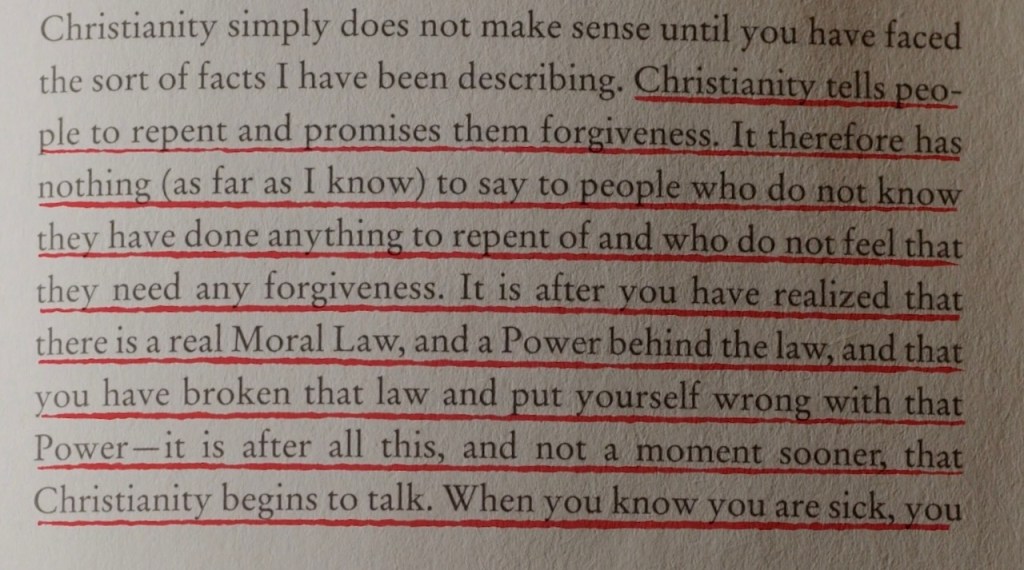
- Human beings know the moral law.
- We still choose to break it.
-> These two truths form the foundation of all clear thinking about ourselves and the universe we live in.
-> We fail to live up to the very standard we acknowledge as objectively real in this world. Our conscience reminds us of this through feelings of shame and guilt, which are universal to the human experience—whether one believes in God or not.
-> As an atheist, Lewis’s main argument against God was that the universe seemed so cruel and unjust. But then he began to question – what was he comparing this universe to when he called it unjust? “A man does not call a line crooked unless he has some idea of a straight lie […] If the whole universe had no meaning, we would never have discovered that it has no meaning.”
-> This realization eventually led Lewis from atheism to theism, as his recognition of an objective moral standard pointed him to the existence of an objective Lawgiver.
-> Moral law is an expression of God’s nature. “God neither submit to the moral law, nor writes it. Rather, God propagates it. ”
I also learned an interesting fact from the course: Lewis passed the same day after JFK’s assassination. The British writer Aldous Huxley, author of Brave New World, also passed away on the same day.
If you have never heard of Huxley’s book Brave New World, I highly recommend you look him up in Youtube.
